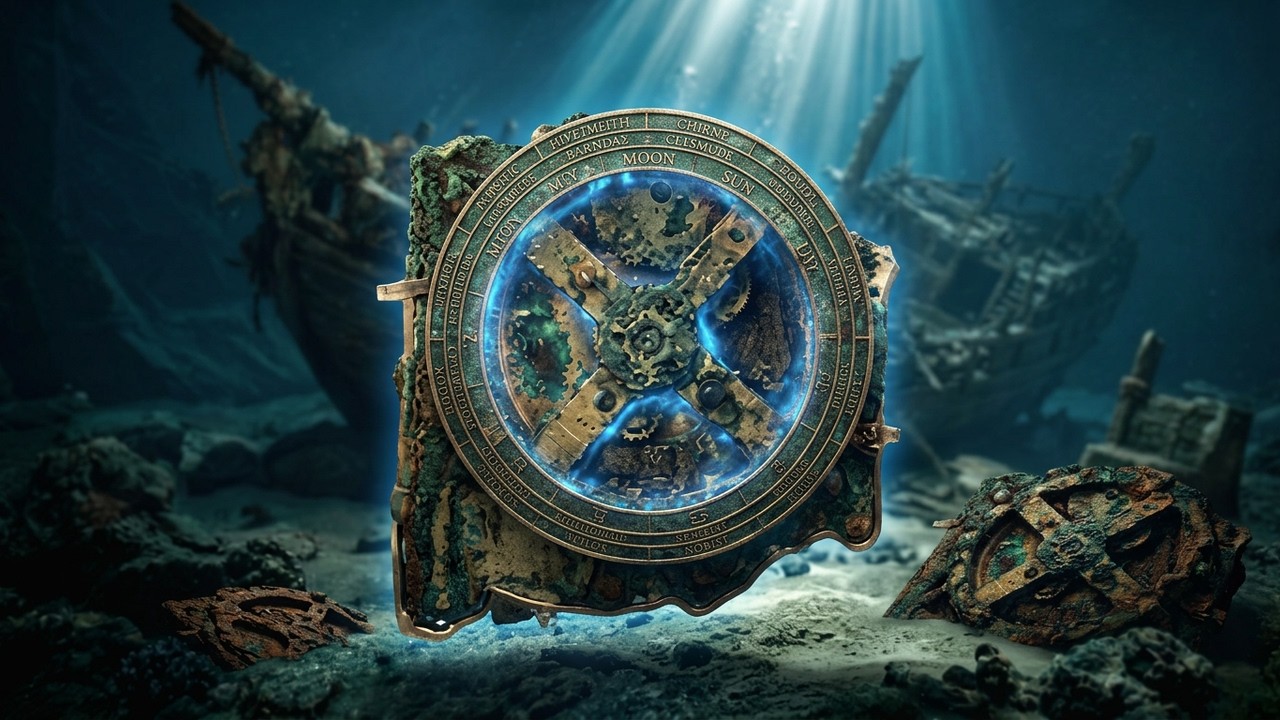
A Shipwreck Nobody Was Looking For
In the autumn of 1900, a group of Greek sponge divers sheltering from a storm near the small island of Antikythera decided to dive while they waited. What one diver encountered on the seabed set in motion one of the most consequential archaeological discoveries of the twentieth century: an ancient Roman-era shipwreck, its cargo still resting where the sea had swallowed it roughly two thousand years earlier.
Over the following months, Greek authorities and divers recovered marble and bronze statues, pottery, glassware, and coins — a remarkable snapshot of the ancient Mediterranean world. Among the objects hauled to the surface was an unassuming lump of corroded bronze that drew little attention. Set beside magnificent marble figures, it looked like debris. It was set aside.
The Lump That Split Open
Months later, the neglected lump cracked apart. Inside were gears — small, interlocking, and unmistakably deliberate. Each tooth had been cut with precision. The gears meshed together in a way that suggested a single, coordinated mechanical system. Researchers at the National Archaeological Museum in Athens were baffled. The shipwreck dated to somewhere around 60 to 70 BCE. Machinery of this mechanical complexity simply was not supposed to exist in the ancient world. At least, that had been the assumption.
The object became known as the Antikythera Mechanism, named for the island near which it was found. For decades it resisted full understanding. The corrosion was severe, many fragments were missing, and the technology needed to look deeper into the surviving bronze did not yet exist.
What X-Rays and CT Scans Revealed
The real breakthrough came in stages across the second half of the twentieth century and into the twenty-first, as imaging technology improved. X-ray analysis in the 1970s by physicist Derek de Solla Price produced the first serious mechanical reconstruction. More recently, high-resolution CT scanning has allowed researchers to read inscriptions buried inside the device and map its full gear train with much greater accuracy.
The picture that emerged is extraordinary. The Antikythera Mechanism was not a clock, nor an ornament. It was a working astronomical calculator. A user turned a hand crank, and a system of at least 30 bronze gears — some researchers believe the original device had more — translated that movement into the positions of celestial bodies. The device could display the current phase of the moon, track the cycles of the sun, and model the movements of at least some of the planets visible to the naked eye.
Most strikingly, it could predict solar and lunar eclipses. It did so by encoding the Saros cycle — an 18-year repeating pattern of eclipses known to Babylonian astronomers — directly into the gear ratios. Turn the handle forward, and the machine would show you an eclipse that had not yet happened. This was not divination. It was applied mathematics, built in bronze.
More Than Eclipses: The Olympic Games Dial
The eclipse-prediction function draws most of the attention, but it wasn’t the only thing the mechanism tracked. In 2008, a research team re-examined one of the small subsidiary dials on the back of the device — a dial previously assumed to track a 76-year astronomical cycle — and found something unexpected: it wasn’t astronomical at all. Its pointer completed one full circuit every four years, and its inscriptions named the major Panhellenic athletic festivals: Olympia, Nemea, Isthmia, and Pythia.
The mechanism, in other words, didn’t just model the sky. It linked the sky to the human calendar Greeks actually used to date events across a politically fragmented world — the four-year Olympiad cycle. A device built to calculate when the moon would darken was also built to tell you when the next Olympics would be held. That combination, connecting the movements of celestial bodies to something as ordinary as a sports schedule, surprised the researchers who found it as much as it surprises most people encountering the mechanism for the first time.
The Question of Authorship
Once the mechanism’s sophistication became clear, one name began appearing repeatedly in academic discussions: Archimedes of Syracuse, the third-century BCE mathematician and engineer whose documented inventions — including compound pulleys, war machines, and what ancient sources describe as a mechanical model of the heavens — placed him at the outer edge of ancient engineering capability.
It is important to be direct about the evidence here: there is no proof that Archimedes built the Antikythera Mechanism. None. The device post-dates his death by roughly a century and a half. What historians note is that the level of mechanical sophistication involved is consistent with a tradition of scholarship that Archimedes represents — and that ancient texts, including writings by Cicero, describe devices similar to the mechanism that were associated with his circle or his legacy. Whether the mechanism’s makers were directly inspired by his work, were working from a shared intellectual tradition, or whether the Archimedes connection is simply the result of modern pattern-matching onto a famous name remains genuinely unresolved.
The same 2008 study that identified the Olympiad dial added a more specific piece of evidence to this picture. The mechanism’s calendar uses month names that are distinctly Corinthian in origin, rather than generic Greek ones — and Corinth’s major colony in the ancient world was Syracuse, Archimedes’ home city. That doesn’t prove Archimedes built the device, or even that its makers had read his work. But it does narrow the geographic and cultural tradition the mechanism came from to somewhere with a direct, documented link to him — a more specific claim than the general “this fits his level of sophistication” argument historians relied on for decades.
Why Is There Only One?
Perhaps the most persistent question surrounding the Antikythera Mechanism is why it appears to stand alone. In more than a century of archaeology across the Mediterranean world, nothing mechanically comparable has surfaced. This absence is itself a puzzle with several possible explanations, none of them provable.
The mechanism’s bronze gears would have had significant material value. In a world where metal was routinely melted down and reused, such objects would have been among the first things recycled in times of scarcity or conflict. It is also possible that the device was rare to begin with — a luxury instrument owned by wealthy patrons or institutions, produced in small numbers by highly specialized craftsmen whose skills did not survive the political and economic disruptions of the late ancient world. Alternatively, similar devices may yet remain buried or submerged, simply not yet found.
What Remains Open
Has the Antikythera Mechanism been “solved”? Not entirely — and probably never completely — but the honest answer isn’t “no” either. The device is now housed at the National Archaeological Museum in Athens, where ongoing research continues. Modern scholars understand its eclipse-prediction function, its lunar calendar, its Olympiad dial, and significant portions of its planetary display. A major international research effort published in 2021 proposed a reconstruction of the device’s front face, including a model of all five planets known to antiquity — though that reconstruction remains a working hypothesis rather than a settled conclusion, and other researchers have offered alternative interpretations.
What the mechanism confirms, without ambiguity, is that the intellectual capacity of the ancient world was more sophisticated than nineteenth-century historians assumed. The device encodes knowledge of Babylonian astronomy, Greek geometry, and precision metalworking in a single object. Whoever built it understood, at a practical level, that the sky follows rules — and that those rules could be modeled in metal and made to run on a crank.
The corroded fragments that a diver pulled from the sea more than a century ago still hold unanswered questions. But what they have already told us has permanently changed the story of what ancient engineering was capable of.
Sources referenced in this file
- Freeth, T. et al. (2021). ‘A Model of the Cosmos in the ancient Greek Antikythera Mechanism.’ Scientific Reports, 11, 5821.
- Freeth, T. et al. (2008). ‘Calendars with Olympiad display and eclipse prediction on the Antikythera Mechanism.’ Nature, 454, 614–617.
- Price, D. de Solla (1974). ‘Gears from the Greeks: The Antikythera Mechanism.’ Transactions of the American Philosophical Society, 64(7).
- Marchetti, N. et al. — Antikythera Mechanism Research Project (ongoing). antikythera-mechanism.gr
- Cicero, De Re Publica, I.21–22 (ancient reference to Archimedes’ celestial sphere)